If you want to make me cringe well, apart from showing me some uber horrible reality TV show, show me an artist statement with the words “The Viewer” in it.
I really really hate those words. Sure, they are just two little words and, in the grand scheme of things, what’s two little words, right? WRONG! UGH! I hate them with every fiber of my being!
Allow me to explain.
Some Assembly Required
I generally dislike artist statements that tell people what they’re supposed to see, feel, or experience. “The viewer” fails for me on many levels actually. It sounds like an instruction manual…
"IKEA photograph. To assemble, The Viewer should look here first!"
Imagine a stick figure holding a framed print in true IKEA fashion. It’s like reducing art to a cardboard cutout of itself! But, also it removes the immediacy about the process. It’s like somebody using passive voice instead of active voice when giving commands. It’s like, instead of saying, “Stop! Put your pencil down!” instead, you say, “The test taker should now refrain and the pencil should now be placed in the lowered position.”
This just doesn’t hit the same.
“The Viewer” also feels very gallery-esque or art speak to me. I imagine a stuffy man with a beret and an ascot telling people, “The viewer shall now engage with the juxtaposition of light and shadow in the chiaroscuro elements of the compositional balance…”
It’s like the first leaf of lettuce in a word salad and I want to banish it from my kingdom!
The Trouble with “The Viewer”
If I really analyze this, it’s not the two little words, no, it’s that I really object to language that creates unnecessary distance between the artist, the artwork, and the experience.
Whenever I read, “The Viewer,” I somehow think there is a presumption of a response. When an artist writes, “…invites The Viewer to…” they’re basically assigning an experience to someone who hasn’t even encountered the work yet. How are they supposed to know what to feel about it if they haven’t even seen it yet? It’s backwards!
If this were not bad enough, “The Viewer” invites a loss of immediacy. The “Stop! Put your pencil down!” example demonstrates this. Indirect, bureaucratic language drains the energy from the room. It’s exhausting! The problem is not only passive voice, it’s the peculiar combination of abstraction, formality, and unnecessary distance. Photography is a medium that harnesses light and offers up a heaping helping of immediacy. To come between either of those in your artist statement? Why, I think this is akin to a cardinal sin!
Purple Prose and the Art of Being EDUMACATED
Institutional art language had its place. Years ago, it may have helped separate the folks who, say, worked in a portrait studio from a photographer who had an MFA. The educated photographer wanted to sound, well, educated. So out came the art speak. It was the proverbial way of pounding one’s chest and declaring, “I’m EDUMACATED DAMN IT!” These days, we have YouTube and a prayer. We don’t need art speak, it’s just a pretentious leftover from a bygone era.
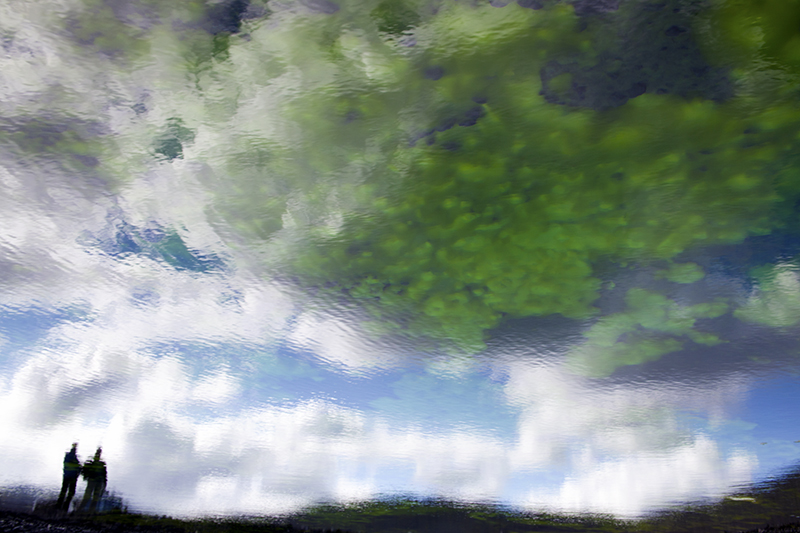
Now, you might say that I’m simplistic, and that might be the case. But, I’d argue, you also might be wrong about that as well. You see, I don’t reject sophisticated ideas. No, quite the opposite. Sometimes, I lean into them. My artwork explores some fairly complex questions like identity, reality, representation, and perception. I often work in the abstract and usually with layers that add a certain depth to my work.
I just reject the idea that sophisticated ideas require a sort of purple prose art speak to describe them. You can talk about a sophisticated idea without serving up a word salad.
Personally, I’ve written poetry, haiku, prose, song lyrics, and other forms of writing without resorting to the hoity-toity highbrow elbow patch wearing language you might hear in the lounge while wearing your dinner jacket and smoking a pipe. We can be intellectually rigorous without sounding academic and without having to prove our existence to the hoi polloi masses.
Curiosity Doesn’t Come with Instructions
Perhaps, more importantly, I strive to be able to discuss my work without telling people what they’re supposed to think. I don’t club you over the head with meaning. Often, I work in the abstract, but I almost always let you find meaning in what I do.
Curiosity is a big part of what I do and who I am and my artist statements reflect that. My curiosity can be shared without prescribing a response, in fact, I feel it’s more accurate if my artist statements invoke a sense of curiosity in you as well. I like to spread it around, what can I say?
I don’t know what you’re going to see in my photographs. That’s half the fun for me. I know what I saw, what I was thinking, and why I pressed the shutter. The rest is up to you.
I also know that you won’t see “The Viewer” in my artist statement. Not anytime soon anyway.
Until next time…