
The stroopwafels have all been eaten, the laundry done, and now it’s time to share with you the top 10 things this New Yorker discovered about Old Amsterdam. For those of you who are a fan of my top 10 lists, this is the latest in the series.
10. The cheese – A New Religion of Flavor
The Dutch have elevated cheese from an ordinary sandwich fixing into something approaching an art form.
Gouda (properly pronounced more like HOW-dah in Dutch) is named after the Dutch city of Gouda, which is not too far (southwest) of Amsterdam. It’s a short train ride or, as I was told, you could practically roll the cheese wheel there yourself.
I never knew Gouda was near Amsterdam. I never knew Amsterdam had a cheese thing. I never knew the Amsterdam cheese thing was practically a religious experience, complete with shops that hand out all kinds of free samples and items on the menu that look like your typical “grilled cheese sandwich” but actually taste something just short of divine.
Wash it down with a local beer and you hit that divine spot pretty quickly.
At one point, I visited a cheese shop on the corner of a canal (like everything in Amsterdam!) where they hand out samples of everything. All kinds of cheese, even some you think could not possibly exist.
I am a cheese-avore and was afraid of wanting to try so many samples they would kick me out of the shop. Luckily, there were some pushy Canadian tourists eating everything in sight while I was in the cheese emporium. I wound up eating everything in sight but taking smaller bites than the Canadians. I might have hidden behind a giant cheese wheel while doing so.
9. The Canals – A Belt You Can Sail
Amsterdam has about 165 canals, totaling more than 60 miles of waterways. There are also about 1,400 bridges, depending on how you count them.
Amsterdam is famous for its Grachtengordel or canal belt. Because of the canals, Amsterdam is nicknamed The Venice of the North.
The canals are not natural (I was told this on my boat ride!) The famous canal belt was dug out during the 17th-century expansion.
Being trained as an engineer, I found it fascinating to visit the canals. I have been to the locks on the Saint Lawrence River before, and locks are interesting feats of engineering in and of themselves, but Amsterdam’s canals were really special. There are probably no better engineers in the field of water management than the Dutch. It shows in their canal system and in many other designs they produce. Nobody else makes roads that go under waterways quite like the Dutch!
Historically, as the city grew, urban planners of old undertook an ambitious expansion project. They constructed a series of roughly concentric canals around the medieval center of the city.
The three most famous canals are:
• Herengracht — Gentlemen’s Canal, associated with wealthy merchants and prominent residents.
• Keizersgracht — Emperor’s Canal, named for Holy Roman Emperor Maximilian I.
• Prinsengracht — Prince’s Canal, named for the Prince of Orange.
The Prinsengracht is the canal that the Anne Frank House stands alongside.
I found, while walking the canal ring, it was easier to navigate by canal than it was by road or street name. For the duration of my visit, except for the boat ride, I pretty much stayed in the Nine Streets (Negen Straatjes) district, which consists of nine small streets connecting the major canals.
In 2010, Amsterdam’s 17th-century canal ring was designated a UNESCO World Heritage Site.
Much of Amsterdam was built on marshy, waterlogged land. The Dutch had to figure out how to drain it, control the water, and create usable land for buildings.
When they excavated the canals, they also used the removed earth to help raise the surrounding land.
The canals served multiple purposes. They provide transportation, a path for trade, water management, and some of the canals formed part of the city’s defensive boundaries. This was remarkably sophisticated urban planning for the 1600s.
I was told too that occasionally they drain the canals. They fish a lot of bicycles (and other things too!) out of the bottom of the empty canals.
I found walking the canals to be a fun experience. It’s easy to get lost, which is both a wonderful experience and one that leaves you wanting to stop and get a bite of cheese (see Number 10) before attempting to find your hotel (again!)
8. The Dutch Apple Pie – A Slice of Heaven!
I always heard the term “Dutch Apple” but somehow never connected it with Amsterdam (honestly, I don’t know where I thought it came from, I just never connected the dots there.) Visiting Amsterdam, I got to experience the authentic Dutch Apple pie. Oh, it’s so good! Coming from New York originally, I am no stranger to apples, in fact, I love them. Apple season is a favorite of mine and New York is apple country, as they grow there quite well. I must confess, I’m not the biggest apple pie person but, having a fresh Dutch apple pie made correctly? With heaping apple slices, real whipped cream, AND ice cream on top? Oh, now that gets a big “Yum!” from me right there.
The Dutch Apple pie is a wonderful dessert treat when visiting Amsterdam. You can find a Dutch Apple pie on a lot of menus and there are some specialty shops that bring home the Dutch Apple goodness scattered around the canal zone.
7. The Canal Houses – Hiccup! The Buildings Are Drunk
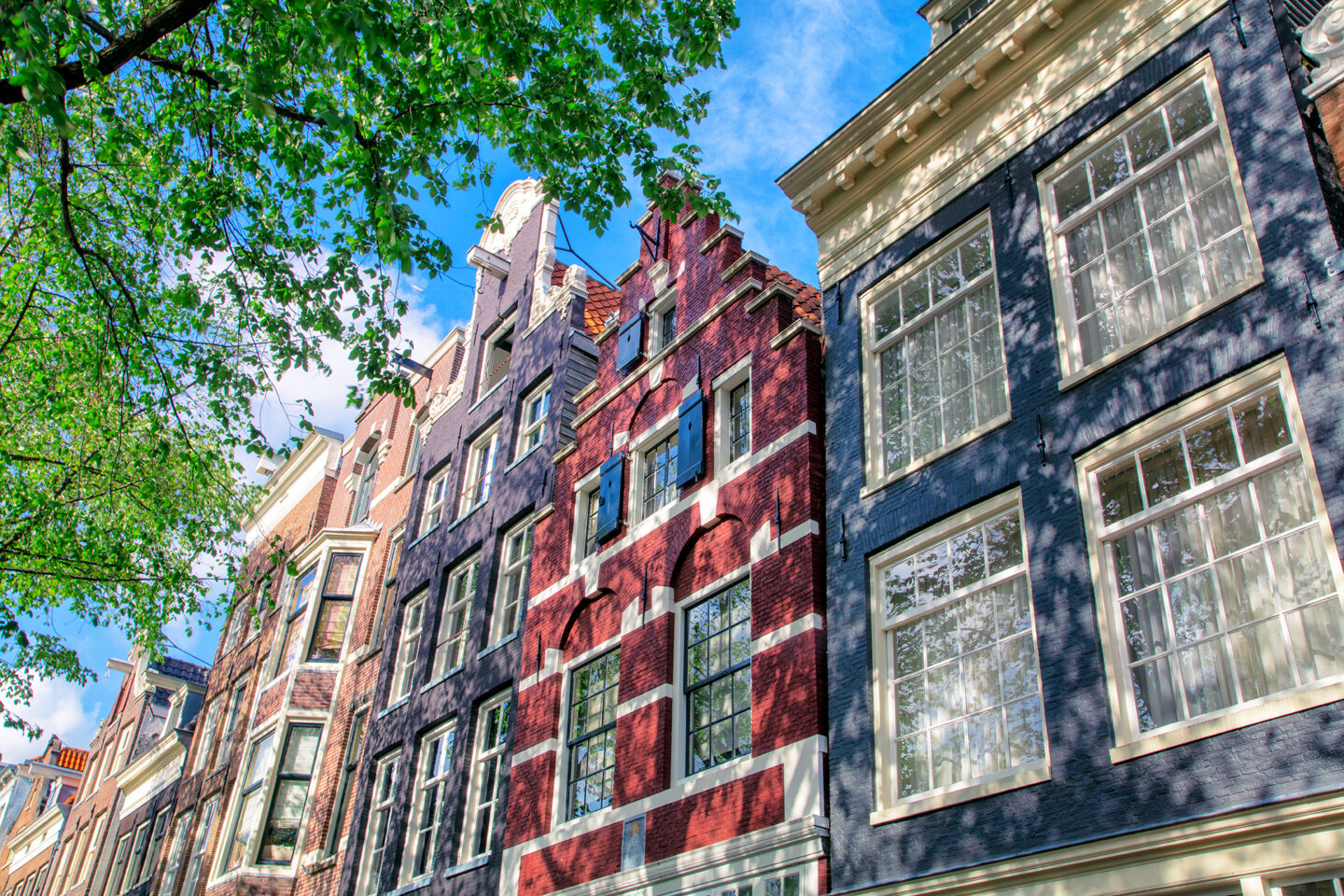
Amsterdam is famous for the canal houses. These are tall but narrow row buildings, connected and built along the canals. Many of them have now been converted into more modern buildings on the inside, while retaining the historic charm of Amsterdam’s Golden Age.
For both of my visits to Amsterdam, I stayed in canal houses that had been converted into modern hotels. When I was picking out hotels for the visit, I wanted a few modern features, notably a lift (elevator as we call it in the ‘States) and a place to eat, like a bar, restaurant, or cafe.
The first hotel I stayed at had a courtyard and my room overlooked that. For my second hotel, I had a canal view room, one where I had a series of windows overlooking the canal itself. Both were excellent choices, although I might recommend that, if you are not a heavy sleeper, you might want to try to get a canal view room on an upper floor, since the canals can be a bit noisy at night.
Amsterdam is home to some canal houses they refer to as “drunken buildings” on account of the fact that they lean. Some have drooped this way over the years, while others were designed this way in order to hoist goods through the upper floor windows.
In Amsterdam, it’s not uncommon to see a canal house with a hook at the top, in the gable or along the roofline. These hooks are attached to hoisting beams. Because the staircases were narrow and steep, residents used pulleys to lift heavy objects through the windows.
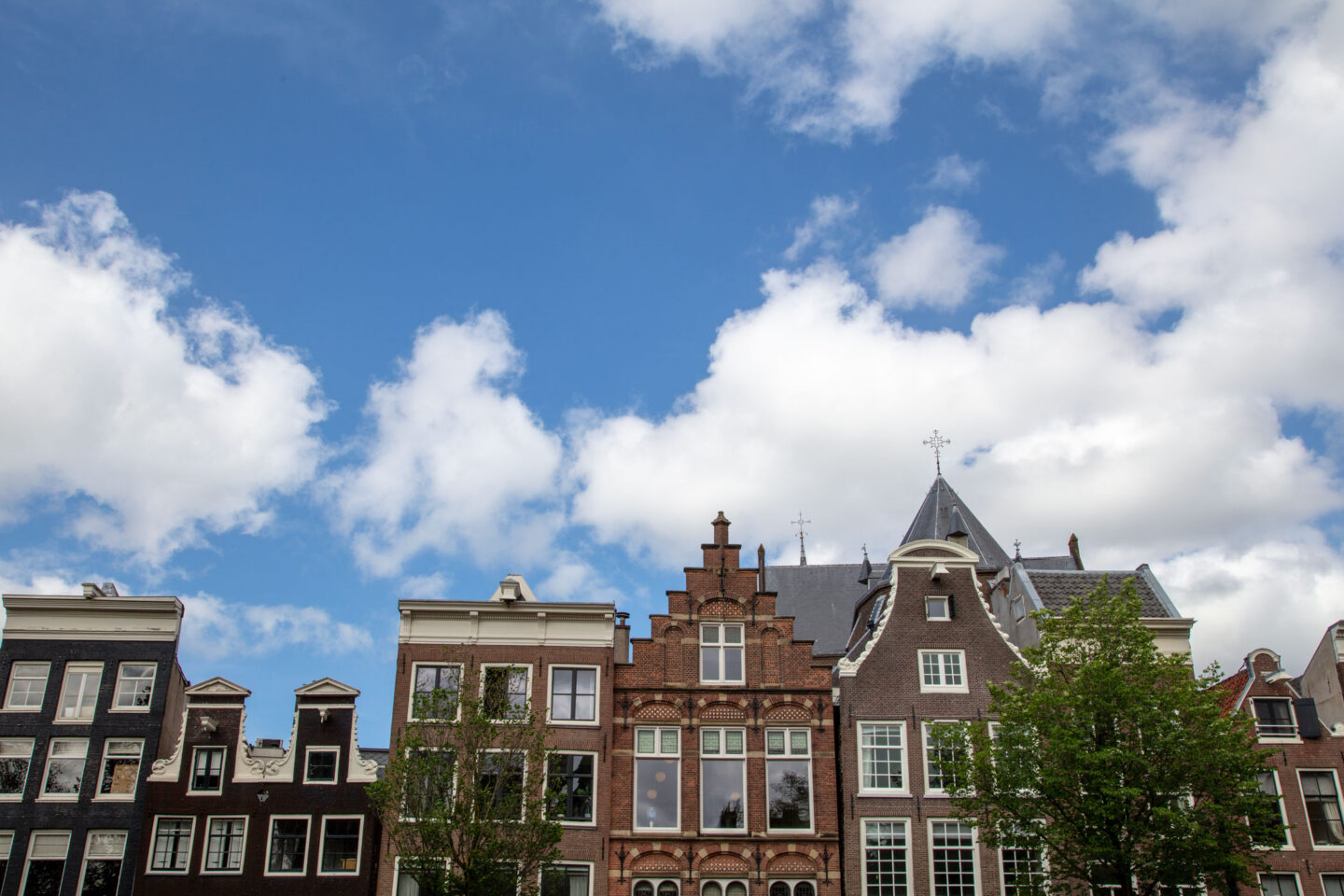
Stepped gables are among the oldest styles of roofline you’ll encounter on Amsterdam’s canals, but there are several different styles of canal house you can spot if you look carefully:
• Stepped gables: Stair-step shapes, especially associated with older Dutch architecture.
• Neck gables: A narrower upper section with decorative curves or scrollwork.
• Bell gables: Rounded shapes resembling the outline of a bell.
• Spout gables: Simpler triangular forms associated with warehouses and utilitarian buildings.
These gables give Amsterdam’s streets much of their distinctive character.
The canal houses historically have been used for homes, businesses, and warehouses, sometimes all at once. The merchants could live upstairs, do business on the ground floor, and store goods in the attic or top floors.
One thing I noticed about the canal houses too was that a lot of them had a ton of windows overlooking the canals. Because they are attached on the sides, and because Amsterdam is a northern city, in order to let the light in, they used a lot of windows, sometimes even entire walls of windows made up the front, canal-facing part of the house.
I loved the canal houses. Staying in a converted canal house was fun, especially since it afforded me modern amenities but had such a rich tradition in Amsterdam. I would highly recommend it if you are thinking about visiting the city and, an important footnote, Amsterdam is now limiting the conversion and number of hotels along the canals. They don’t want overtourism, as too much of a good thing is no longer such a good thing.
6. Bitterballen and Beer – Dutch Pub Culture
Amsterdam is home to many pubs and the pub culture thrives there. As you walk along the canal belt, you can spot them as they are scattered about the zone. Some of the pubs are quite small and look more like neighborhood pubs while others are larger and more rowdy but still serve as a gathering place for the locals to pop in and grab a pint.
When I was there, I opted to partake in a local cuisine known as bitterballen. These are basically croquettes. Think of it as a small bite meal, an appetizer really but a tasty one. They can sometimes come with dipping sauces (mine did) and are usually washed down with beer. (Mine was.)
The local beer is actually Heineken but you can spot many types of beer in the canal zone. Almost as many beers as there are taps in the canal pubs.
5. The New York City Connection
My hometown, New York City, was originally called New Amsterdam when it was a Dutch colonial settlement in the 17th century. My Dad attended Stuyvesant High School which was named after Peter Stuyvesant (c. 1612–1672), the last Dutch director-general of New Netherland, which included New Amsterdam (now New York City).
Peter Stuyvesant was nicknamed “Peg Leg” because he really did have a peg leg. In 1644, while fighting the Spanish on the Caribbean island of Saint Martin, Stuyvesant was struck in the right leg by a cannonball. His leg had to be amputated and he later wore a wooden leg.
Apart from New Amsterdam, there are many places in the Netherlands that are namesakes for their New York counterparts. There’s Brooklyn, which comes from Breukelen, a Dutch town, Harlem comes from Haarlem, a Dutch city. The Bronx takes its name from Jonas Bronck, who was associated with the Dutch colony, Staten Island comes from Staten Eylandt, named for the Dutch States General. Coney Island may even have roots in the Netherlands, likely deriving from the Dutch Conyne Eylandt, meaning Rabbit Island.
I always knew New York was called New Amsterdam and it was fascinating to visit OLD Amsterdam (the original!) to see this influence firsthand.
Amsterdam reminded me of my hometown in many ways, but was different too.
They also say Amsterdam is The Venice of the North and it kind of felt to me that Amsterdam was like a cross between Venice and New York, although I fully recognize New York is the true baby in that equation.
4. The Glorious Stroopwafel
A stroopwafel is a round disc-like dessert treat that usually contains syrup, brown sugar, butter, and cinnamon.
It’s conveniently round, as the Dutch have a little trick to enjoying them. You are supposed to place the flat stroopwafel over the top of a steaming hot cup of coffee or tea. The heat will soften the filling making it wonderfully gooey. This is practically a Dutch engineering achievement disguised as a cookie.
Before I went to Amsterdam, I visited my sister in California. We went to World Market and got some stroopwafels there, joking that I probably wouldn’t see any real stroopwafels on my trip, as they probably just export them all to tourists in California.
In Amsterdam, they have a place I dubbed The Stroopwafel Factory which was a bakery. It wasn’t just a bakery, it was a block-long bakery where they make giant batches of stroopwafels with all kinds of toppings (hello, sprinkles!)
To get to this particular bakery, from my hotel, you didn’t need directions. Nope. Instead, you could just sniff your way there, using the aroma of the baking stroopwafels as your nasal GPS.
The bakery where they make the stroopwafels was incredibly fragrant. You really could smell it coming. Even the sprinkles stunk up the joint.
3. The Canal Boat Rides – Going Gangsta with a Fresh Pint
When I booked my hotel, I saw that there was an option to take a canal boat ride. I thought a canal boat ride might be a nice way to see the city even while suffering from jet lag. It seemed like a great idea, as you can just sit comfortably while the boat does all of the work.
When I booked my boat ride and boarded the boat, we had a tour guide who told us that the boat was once owned by the Heineken family, the famous brewers of Dutch beer. The boat was named the Stan Huygens and had an interesting backstory.
In 1983, Alfred Henry “Freddy” Heineken, grandson of the company’s founder, was kidnapped in Amsterdam along with his chauffeur, Ab Doderer.
The kidnappers demanded a high ransom but both men were eventually freed after being held captive for about three weeks.
The yacht also features bulletproof glass, perhaps not surprising given Freddy’s history. It is also one of the yachts that has a head on it (many boats on the canals do not.) It featured a back booth that looked over the entire vessel with leather seating, fancy lights, and two bars (of course, each with Heineken on tap.) I got to sit in the back booth for my cruise.
So, I was floating around Amsterdam on a boat once owned by the Heineken beer guy that had bulletproof glass and a head. In Amsterdam, that’s about as gangsta as you can get.
Word to your Stroopwafels.
2. The Anne Frank House – A City Remembers
As I walked out of my hotel, if you looked in one direction, there was a large church steeple. It was visible from a lot of the canals. At first, I didn’t know what it was.
Then, I went to visit the Anne Frank House.
Turns out the steeple is from the church right near where she lived. It’s a church called Westerkerk, one of Amsterdam’s most recognizable landmarks, and its tower is called the Westertoren.
Anne wrote about hearing the bells of the Westerkerk while she was hiding in the Secret Annex. The church was part of the world outside that she could hear but couldn’t freely experience.
For my visit, I decided I was not going to spend a lot of time inside. I skipped the museums and the like, because, in Amsterdam, many of them have big lines, big crowds, and book well in advance. I was only there for a few days and was taking lots of photos in the early summer nice weather, so I skipped most indoor activities.
I did walk down near the big church steeple and stopped in front of the Anne Frank House. It was quite an experience.
Something I hadn’t realized about Amsterdam was how impacted by World War II the city actually was. The war was brutal and the Dutch relationship with it was complicated.
The Anne Frank House is an example of this. It’s right in the middle of the city. It’s where she hid. It’s where the Gestapo once roamed. The city of Amsterdam is, in part, carved and shaped by its history. In typical Dutch fashion, they remember history and are direct about events from the war.
Next to the church, at the bottom of the steeple, is a statue of Anne Frank. It’s a small statue. I was told it might be close to life-sized. The statue near the Westerkerk depicts Anne standing with her hands behind her back. It was created by sculptor Mari Andriessen and unveiled in 1977.
I read the diary when I was younger, and I was told in history class that Anne Frank was “a young girl.” Seeing that statue made me realize she was really just a child.
Today, the Anne Frank House stands near the bottom of the old church. In the middle of the canals, the bicycles, the stroopwafels, the cheese shops and galleries, the city remembers its past.
1. The Bicycles – Amsterdam’s Apex Predators
Bicycles are the apex predators of Amsterdam. The bike is THE mode of transportation in Amsterdam, so much so that the city is even sometimes called The Bicycle Capital of the World. It earned this reputation, given that there are more bicycles than people and the bike lanes rule. If you stand in a bike lane and you get run over, too bad. I found that, if you stand on the sidewalk, generally speaking, it’s “safer-ish” but the bikes sometimes go there too. If you hear a bell, run, jump, and hide!
Seriously though, the bike is a wonderful mode of transport in the city, given that it’s flat and the roads narrow. I really enjoyed seeing all of the bikes and it made me want to ride myself. Yes, you can rent bikes there too, for those who want to partake in the most common form of transport in the Venice of the North.
The Runners-up
Some runners-up from my trip:
The building where you can walk on the roof – There is a building in Amsterdam where you can walk on the roof. It’s called the NEMO Science Museum and it’s a green building shaped like a ship. Designed by architect Renzo Piano, it has a large, sloping rooftop terrace that you can walk up to, affording you panoramic views of the city. The rooftop is called NEMO’s Roof and you can visit it without going inside the museum itself when the roof is open.
The zoo where they hid during the war – On my boat ride, we passed the ARTIS Amsterdam Royal Zoo and were told that, during World War II, people actually hid in the zoo, sometimes seeking shelter in animal enclosures with monkeys, wolves, and even bears. The zoo remained open during the war and was also a favorite spot for occupying German soldiers. Remarkably, accounts of the zoo’s wartime history describe people successfully hiding there without being discovered. Amsterdam still maintains the zoo today. It’s a park-like setting that the locals enjoy.
My new favorite airport – The Amsterdam airport is wonderful! I used to love going through Heathrow (I know, I know!) but now I am in love with Schiphol Airport. It’s a wonderful airport with great food, easy to navigate, modern, and comfortable.
The Peacock Palace and The Book Room – One of the hotels I stayed at was a jewel box hotel that was really something. Called Hotel Estherea, I dubbed it the Peacock Palace. I never knew a hotel could be so colorful. It had a floating fireplace, curved teal velvet couches, wild wallpaper, and butterflies in boxes on the walls. There were two hotel cats that roamed the lobby as well. What a crazy (but Instagram-able!) place.
Both hotels were wonderful, but I could not have picked a better landing spot than Hotel Ambassade. It was a quiet, restful introduction to Amsterdam, and the staff and food were wonderful. It also had a library bar, a room full of books with tables featuring games like chess and backgammon. A great spot to relax and unwind after tackling the canals all day long.
Coffeeshop vs. Cafe – In Amsterdam, I was told that a coffeeshop is not what you might expect. A certain plant is tolerated in Amsterdam, and that’s what they enjoy inside such an establishment. If you want a cup of java, you should probably ask for a cafe instead of a coffeeshop.
So, bottom line, would I return to Amsterdam? You bet your stroopwafels I would!
Amsterdam Through My Lens
Amsterdam was as much a photographic adventure as it was a travel adventure. From its historic canal houses to the reflections dancing across its waterways, the city offered endless opportunities for me to see the familiar in unexpected ways.
I’ll be sharing more of my Amsterdam photographs and adventures, so stay tuned! In the meantime, you can explore my fine art photography collections at Carol’s Little World.
My photography has been exhibited, awarded, and published internationally. You can also explore more of my Amsterdam adventures in the related articles below:
One Month. Three Places. One Inspired Bored Peach.
Until next time…